Greenland
Global changes, local impacts: Study of glacial fjords, ecosystems and communities in Greenland
Navigating the New Arctic (NNA) is one of NSF's 10 Big Ideas. NNA projects address convergence scientific challenges in the rapidly changing Arctic. The Arctic research is needed to inform the economy, security, and resilience of the Nation, the larger region, and the globe. NNA empowers new research partnerships from local to international scales, diversifies the next generation of Arctic researchers, enhances efforts in formal and informal education, and integrates the co-production of knowledge where appropriate.
The Greenland Hazards Project
Navigating the New Arctic (NNA) is one of NSF's 10 Big Ideas. NNA projects address convergence scientific challenges in the rapidly changing Arctic. This Arctic research is needed to inform the economy, security and resilience of the Nation, the larger region, and the globe. NNA empowers new research partnerships from local to international scales, diversifies the next generation of Arctic researchers, enhances efforts in formal and informal education, and integrates the co-production of knowledge where appropriate.
Developing community frameworks for improving food security in Greenland through fermented foods
Navigating the New Arctic (NNA) is one of NSF's 10 Big Ideas. NNA projects address convergence scientific challenges in the rapidly changing Arctic. The Arctic research is needed to inform the economy, security, and resilience of the Nation, the larger region, and the globe. NNA empowers new research partnerships from local to international scales, diversifies the next generation of Arctic researchers, enhances efforts in formal and informal education, and integrates the co-production of knowledge where appropriate.
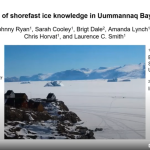
Co-production of Shorefast Ice Knowledge in Uummannaq Bay, Greenland
Johnny Ryan, Sarah Cooley, Brigt Dale, Amanda Lynch, Chris Horvat, and Laurence C. Smith
A Navigating the New Arctic (NNA) project update video produced for the April 2020 virtual NNA Investigators meeting. The video is narrated by Johnny Ryan (Brown University).
2020
Accelerating discoveries at Greenlands marine margins through international collaboration
Most of Greenland is covered by the expansive Greenland Ice Sheet, which, if it all melted, would cause sea level to rise by more than 20 feet. Greenland has been losing ice at a particularly rapid rate since the mid-1990s, with impacts for local and global fisheries. This AccelNet project (GRISONET) is designed to facilitate rapid and effective collaboration-building and foster discovery about the Greenland ice sheet, the ocean, the marine ecosystems and their interactions.
Predicting coastal responses to a changing Greenland ice sheet
Navigating the New Arctic (NNA) is one of NSF's 10 Big Ideas. NNA projects address convergence scientific challenges in the rapidly changing Arctic. The Arctic research is needed to inform the economy, security and resilience of the Nation, the larger region and the globe. NNA empowers new research partnerships from local to international scales, diversifies the next generation of Arctic researchers, and integrates the co-production of knowledge. This award fulfills part of that aim.
The impact of climate change on Greenland's glacial fjords, ecosystems, and local communities
Navigating the New Arctic (NNA) is one of NSF's 10 Big Ideas. NNA projects address convergence scientific challenges in the rapidly changing Arctic. The Arctic research is needed to inform the economy, security and resilience of the Nation, the larger region and the globe. NNA empowers new research partnerships from local to international scales, diversifies the next generation of Arctic researchers, and integrates the co-production of knowledge. This award fulfills part of that aim.
Co-production of shorefast ice knowledge in Uummannaq Bay, Greenland
Shorefast ice (also known as landfast ice) is sea-ice that is attached to the coastline. Since it does not drift with the winds and currents, shorefast ice forms an important habitat for wildlife and a platform for human subsistence food production and transport in the Arctic. As the climate warms, residents local to the Arctic report that it is breaking up earlier in the year and is thinner than it was a few decades ago. These environmental changes threaten the sustainability of wildlife and traditional human activities that depend on shorefast ice.
Sustainable Transitions through Arctic Redevelopment (STAR)
With the launch of the Decade on Ecological Restoration by the United Nations in 2021, momentum is growing towards visioning a sustainable future for aging industrial sites worldwide. In the Arctic, these aging sites, including mining operations, have experienced immense neglect in part due to the remoteness of the region. With climate warming leading to increased ice and permafrost melt and expanded access to the region, these sites are increasingly vulnerable to further deterioration but pose an opportunity to understand how these sites can be developed for the future.
The Integrated Characterization of Clouds, Energy, Atmospheric state, and Precipitation at Summit, Aerosol-Cloud Experiment (ICECAPS-ACE)
The Greenland Ice Sheet is a unique location in the Arctic. It rises from sea level to over 10,000 feet in elevation and is, by far, the largest topographic feature north of the Arctic Circle. Scientists have determined that the ice sheet is sensitive to climatic fluctuations. In spite of its uniqueness and importance, it is relatively under-studied compared to other locations on Earth.