Greenland
Conference: Convergence Approaches to Arctic Coasts
The Arctic is experiencing rapid environmental changes that present challenges to the natural environment, built environment, and social systems that have sustained Arctic peoples and ecosystems for generations. These changes are strongly evident in Arctic coastal systems. New research on Arctic coastal systems has been supported through both the Navigating the New Arctic (NNA) program and the Coastlines and People (CoPe) program. However, coordination and synthesis among these Arctic coastal projects and new perspectives are needed to fully understand these rapid changes.
Negotiating Expertise in the Greenland Hazards Project
Jessica Rich
The Greenland Hazards Project (GHP) partners Earth scientists from the University of Colorado Boulder (CU) and Virginia Tech (VT) with community, science, and government collaborators in Greenland to address the interplay between evolving natural hazards, society and infrastructure in the changing climate of Greenland. The goal is to build capacity for geodesy, remote sensing and machine learning at Greenlandic institutions and in Greenlandic communities.
2022
Modeling a Sustainable Energy Transition in Northern Greenland: Qaanaaq Case Study
Alyssa Pantaleo, Mary Albert, Hunter Snyder, Stephen Doig, Toku Oshima, Niels Erik Hagelqvist
Many remote subsistence communities in the high Arctic rely solely on fossil fuels for heat and electricity. In Greenland, the government has reduced support for subsistence communities that receive significant fuel subsidies. In order to help enable a pathway for subsistence communities in northwest Greenland to continue their right to self determination, the feasibility of cost saving energy system improvements via renewable energy is explored.
2022
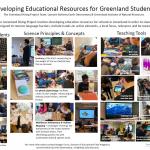
Developing Educational Resources for Greenland Students
The Greenland Rising Project Team: Lamont-Doherty Earth Observatory & Greenland Institute of Natural Resources
The Greenland Rising Project worked with local schools and teachers to develop a suite of educational resources that have been tested by Greenlandic students from 7th grade through high school in three communities. Materials include hands on activities that support science concepts like isostasy, glacial physics, tidal data, sea level change, multibeam bathymetry, habitat mapping and an introduction to STEM careers.
2022

Are Greenland’s Small-Scale Fishers Ready for Individual Transferable Quotas?
Hunter Snyder, Simon Stone
2022
Systems Approaches to Understanding and Navigating the New Arctic (SAUNNA)
The Arctic is the most rapidly changing environment in the world. People living in the Northern Hemisphere are now experiencing the consequences of a changing Arctic, including abrupt shifts in weather patterns, altered availability of natural resources such as fish, minerals and water, and threats to indigenous cultural heritage and economies.
Current and future Arctic community vulnerabilities to sea-ice change and economic expansion
Navigating the New Arctic (NNA) is one of NSF's 10 Big Ideas. NNA projects address convergence scientific challenges in the rapidly changing Arctic. The Arctic research is needed to inform the economy, security and resilience of the Nation, the larger region and the globe. NNA empowers new research partnerships from local to international scales, diversifies the next generation of Arctic researchers, enhances efforts in formal and informal education, and integrates the co-production of knowledge where appropriate.
Innovations in Energy Technologies and Empowerment in Arctic Fishing Communities (aka Qulleq)
Cold Arctic conditions, twenty-four-hour summer sunlight combined with twenty-four-hour winter darkness, and changing coastal conditions are threatening survival of Arctic communities. Many communities currently rely entirely on expensive fossil fuels for their energy needs. The joint impacts of energy cost, changes in fisheries and the environment, and a young self-rule national government are intertwined in ways that are currently threatening the culture and lifestyles of people in Northern Greenland who have long called the region home.
Facilitating increased engagement between the research communities of Greenland and the U.S.: Nuuk, Greenland - August 27-28, 2018
Greenland is an important research site for scientists from around the world. Because of its unique physical environment and geographic location between North America and Europe, the United States has a significant research presence in Greenland. This presence provides opportunities to strengthen bilateral cooperation with the research community of Greenland. At the ''Facilitating Engagement'' workshop leading Arctic researchers from the U.S.
Closing the Water Vapor Exchange Budget Between the Ice Sheets and Free Atmosphere
As the Arctic warms faster than the rest of the planet, understanding the Greenland ice sheet response to changing climate ? and the associated effect on sea level rise - is important for policy and mitigation strategies. A variety of satellite and surface tools currently exist to help understand snow accumulation and the loss of ice from outlet glaciers or melting, but the magnitude of water vapor exchange between the interior ice sheet and the atmosphere remains essentially unknown.