Alaska
Building Capacity for Tribal Climate Adaptation Planning in Alaska
Alaska Native Tribal Health Consortium (ANTHC)
The Alaska Native Tribal Health Consortium (ANTHC) and Institute for Tribal Environmental Professionals (ITEP) provided 3 tribal climate adaptation planning trainings in Alaska from 2016 to 2017 (two jointly sponsored trainings in 2016 and 2017 and a 2017 training sponsored by ANTHC). This report summarizes findings from a web-based questionnaire distributed to tribal participants who attend these trainings to understand what additional resources and support they want to help their climate adaptation planning eforts. Findings are based on the analysis of 21 responses.
2020
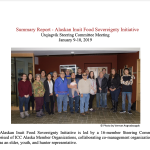
Summary Report - Alaskan Inuit Food Sovereignty Initiative: Utqiagvik Steering Committee
Inuit Circumpolar Council
The Action Plan will empower our people to seek reform and justice as we collectively work towards securing access and management rights over our traditional food resources and to create long-term systematic and policy change that will advance food sovereignty and benefit Inuit communities throughout our four regions of Alaska.
2019

What Lies Beneath? Peat Expansion in the Arctic Tundra (TundraPEAT)
Nicole K. Sanderson, Julie Loisel, Robert K. Booth, Phil Camill, Qianlai Zhuang, Steve Frolking
Will the warming Arctic transform into a peat- and carbon-rich landscape, as the boreal zone is now, or are there essential conditions lacking in a warming Arctic that will prevent this?
2022
TEK Talks: Shifting Perspectives on Working with Indigenous Peoples
Margaret Rudolf, Anika Pinzner
“TEK Talks: Working with Indigenous Peoples" was a successful virtual lecture series on DEI topics and research ethics. It was hosted by the Geophysical Institute Graduate Student Association (GIGSA) at the University of Alaska Fairbanks (UAF) by two graduate students, Margaret, who is Alaska Native, and Anika, an international student from Germany. The series was in part a response to the letter from Western Alaskan Indigenous leaders criticizing NNA. This poster presents lessons-learned from our experience hosting TEK Talks to encourage others to create their own DEI lecture series.
2022
Riverbank erosion and its consequences in the Yukon River Basin
Woodward W. Fischer, Michael P. Lamb, Marie E. Lowe, Edda Mutter, Joel C. Rowland, A. Joshua West, Samantha R. Baker, Rain Blankenship, James L. Dickson, Hannah Dion-Kirschner, Madison M. Douglas, Kieran B.J. Dunne, Emily C. Geyman, Yutian Ke, Nelson Kempt, John S. Magyar, Kimberly L. Miller, Jocelyn N. Reahl, M. Isabel Smith, Alakanuk Traditional Council, Beaver Village Council, Huslia Tribal Council, First Chief Norman Burgett, President Raymond Oney, First Chief Rhonda Pita
Rivers and floodplains are particularly susceptible to a warmer climate due to permafrost thaw that can lead to accelerated erosion. This erosion threatens critical infrastructure and disrupts community life. Here we summarize objectives and early findings from a new NNA project to understand riverbank erosion and its impact on contaminants including heavy metals, such as mercury, along with carbon, nutrients and pathogens.
2022
Responding to Energy Insecurity in Arctic Housing Using Community-Based Participatory Research
Dr. Kristen Cetin, Dr. Cristina Poleacovschi, Dr. Jessica Saniġaq Ullrich, Dr. Bill Gallus, Dr. Bora Cetin, Patricia Guillante, Christiana Kiesling, Amanda Yaa Nkansah Quarshie
Rural communities in Alaska face many housing challenges. Existing housing is generally older, overcrowded, inefficient, and poorly equipped to withstand extreme weather conditions. These challenges result in a high energy burden on homeowners, as well as indoor environmental quality challenges. While there has been substantial efforts to support weatherization to mitigate energy inequality in these communities, the efficacy, service life, and homeowner use of such energy efficiency improvements can be better understood in order to drive further improvements to such programmatic efforts.
2022
NNA Planning: Community-Based Mitigation and Adaptive Strategies for River Flooding and Erosion in Alaska Native Communities
Cassandra Rutherford, Cleo Wolfle Hazard, Kristie Franz, Cristina Poleacovschi, Amelia Wells, Kellie Cutsinger, Pratik Poudel, John Seagrist, Chief Mike Williams Sr., Joel Niemeyer
Here we present preliminary planning work to inform village and regional decision making on mitigation and adaptation strategies. This work has been completed in collaboration with communities on the Kuskokwim River between 2021 and 2022, with the goal of co-generating a research design and approach for a multi-site study integrating local knowledge, Indigenous science, and western science.
2022
Learning by Doing: Collaborative practice with the Native Village of Point Lay and regional partners on an NNA Track 1 project
Jana L. Peirce, Billy Connor, Tracie Curry, Benjamin M. Jones, Anja Kade, Mikhail Kanevskiy, Gary P. Kofinas, Dmitry J. Nicolsky, Vladimir E. Romanovsky, Yuri Shur, Vanessa Stevens, Donald A. Walker
Funded in 2019, the NNA Track1 project, Landscape Evolution and Adapting to Change in Ice-rich Permafrost Systems (NNA-IRPS) aspired to work with the Native Village of Point Lay and several regional partners to determine the best ways to engage the community in research and to ensure the research questions themselves and the data produced will be useful at the local and regional level.
2022
Integrating Indigenous Knowledge to Co-Design more Effective Operations, Maintenance, and Management of Water Infrastructure in the Arctic
Michaela LaPatin, Nikki Ritsch, Miriam Tariq, Daniel Armanios, Suzanne Pierce, Lynn Katz, Leif Albertson, Lissa Pearson, Kasey Faust
Rural Alaskan communities experience significant challenges in developing and operating water and sewer infrastructure systems. Their remote location, freezing temperatures, and regulatory hurdles often inhibit their ability to provide adequate water services. Moreover, engineered water systems are sometimes designed without using local knowledge and experience. Finally, training and certification requirements are often unreasonable and not suited to the local population, creating a gap in the local workforce.
2022
Foundations for Improving Resilience in the Energy Sector against Wildfires on Alaskan Lands (FIREWALL)
Mohammad Heidari Kapourchali, Payman Dehghanian