Land
The Russian Maritime Arctic
Lawson W. Brigham
The Russian maritime Arctic stretches more than 160 degrees longitude from the Norwegian-Russian border in the west, to the Bering Strait in the east. It is Russia’s vast northern coastline, an open border to the Arctic Ocean, and a marine space that presents both strategic vulnerabilities and economic opportunities. The entire coastal area is arguably undergoing the most profound changes of any region in today’s Arctic. This essay seeks to identify key influential drivers of change, and uncertainties that will plausibly determine the region’s future.
2022

Infrastructure and Community Resilience in the Changing Arctic: Status, Challenges, and Research Needs
Ming Xiao
Permafrost thaw is one of the world’s most pressing climate problems, already disrupting lifestyles, livelihoods, economies, and ecosystems in the north, and threatening to spill beyond the boundaries of the Arctic as our planet continues to warm. To examine the effects of permafrost degradation, and increase our understanding of what this phenomenon means for the future of the region (and the world), The Arctic Institute’s new two-part permafrost series aims to analyze the topic from scientific, security, legal, and personal perspectives.
2021
Breaking the Ice: ISE to Play Key Role in Shaping the Arctic's Future
Thomas C. Sharkey, Thomas Birkland, Martha Grabowski, Marie Lowe, and William (AI) Wallace
Changing sea levels open northern shipping lanes but create new logistical challenges.
Transforming permafrost coastal systems: Advancing scientific discovery through international collaboration
Dr. Benjamin Jones and Prof.Hugues Lantuit
In the Alaskan Arctic, permafrost coastal systems are eroding at rates more than double those of the past. Rampant environmental change is putting new pressures on Arctic coastal dynamics, with the loss of landscapes, cultural heritage, infrastructure, and communities.
2019
Arctic Wildland Fire Sharing Circle Summary Report
Arctic Council
The event brought together multiple Working Groups, diverse participants, and a range of projects active and planned for the Arctic in an innovative way to learn, share, and discuss. It fostered a spirit of inclusiveness, and was unique in looking across borders and Working Groups to bring a truly circumpolar lens to wildland fire in the Arctic.
2022
Wildlife Management Summit Report
Inuit Circumpolar Council
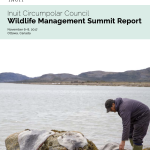
The Inuit Circumpolar Council (ICC) hosted the Wildlife Management Summit that took place on November 6 to 8, 2017 in Ottawa, Ontario, Canada to deliver on the commitment made in Article 40 of the Kitigaaryuit Declaration, as adopted at the 2014 ICC General Assembly in Inuvik, which, “directs ICC to plan and host an Inuit summit on wildlife management.” The ICC Wildlife Management Summit’s goal was to examine the influence that policies (international, regional, national instruments), environmental change, public perceptions, and changing social economic conditions in the Arctic are having
2017
Summary Report - Alaskan Inuit Food Sovereignty Initiative: Utqiagvik Steering Committee
Inuit Circumpolar Council
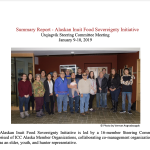
The Action Plan will empower our people to seek reform and justice as we collectively work towards securing access and management rights over our traditional food resources and to create long-term systematic and policy change that will advance food sovereignty and benefit Inuit communities throughout our four regions of Alaska.
2019
Summary Report - Alaskan Inuit Food Sovereignty Initiative: Bethel Steering Committee
Inuit Circumpolar Council
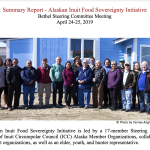
The Action Plan will empower our people to seek reform and justice as we collectively work towards securing access and management rights over our traditional food resources and to create long-term systematic and policy change that will advance food sovereignty and benefit Inuit communities throughout our four regions of Alaska.
2019
Foundations for Improving Resilience in the Energy Sector against Wildfires on Alaskan Lands (FIREWALL)
Mohammad Heidari Kapourchali, Payman Dehghanian
Balancing Wildfire Risks and Power Outages due to Proactive Public Power Safety De-Energizations
Jinshun Su, Payman Dehghanian, Miguel A. Lejeune
Faults on overhead power line infrastructures in electric power distribution systems (DS) can potentially ignite catastrophic wildfires, especially in areas exposed to high wind regimes, low humidity and dense vegetation. The common practice adopted by electric utilities to build resilience against such electrically-induced wildfires is called public-safety power-shutoff (PSPS): strategies to intentionally and proactively de-energize power line infrastructures to prevent wildfire risks.
2022