June 2022 Newsletter
- Propose a Session for the 2022 NNA Annual Community Meeting
- Provide Input on Convergence Working Group Themes
- NNA-Themed AGU Sessions Now Accepting Abstracts
- NNA-CARPE-NRT Student Opportunity
- Funding Opportunities
- Circumpolar Inuit Protocols on Equity and Ethical Engagement
- Atauttikkut - Inuit Youth Connect
- NNA Project Highlight: Fate of the Caribou
- Upcoming Events
Spring Special Issue
- Note from the NNA-CO: Looking back, Looking forward
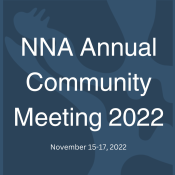
- Save the Date: 2022 NNA Annual Community Meeting
- New NNA-CO Logo
- Launch of NNA-CO's Arctic Together Podcast
- NNA 2022 Photo Contest
-
The 2022 NNA Annual Community Meeting was held November 15–17, 2022, in Anchorage, Alaska, hosted by Alaska Pacific University. The meeting included in-person, hybrid, and virtual sessions and events and brought together NNA researchers, research partners, Indigenous community and organization representatives, decision-makers, and others interested in the NNA initiative.
May 2022 Newsletter
- NSF Virtual Grants Conference
- Funding Opportunity: NSF Convergence Accelerator
- Resources for Planning Virtual Experience Tours
- Meet Sierra, the NNA-CO Community Extension Office Student Intern
- Arctic Research Community Survey
- NNA Project Highlight: Predicting Coastal Responses to a Changing Greenland Ice Sheet
- Upcoming Events
-
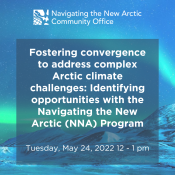
Convergence research brought together diverse participants to develop new perspectives and solutions around complex societal challenges through intentional relationship building and shared understanding. The NSF-funded Navigating the New Arctic Community Office (NNA-CO) supported Arctic-focused convergence research, including the development of four Convergence Working Groups that brought together researchers, local experts, and community representatives to collaborate on focused projects. The Working Groups applied convergence concepts as test beds for best practices, with formation processes open for community feedback and areas of focus aimed to be solidified by early 2023. A webinar was held to share more about convergence research, the Working Groups, and broader opportunities for cross-community interaction within the NNA-CO.