NNA-CO at AGU25: C33A - Convergence Research in the Arctic: Drawing from Diverse Disciplines and Knowledge Systems to Address Complex Societal Challenges
The Arctic region, alongside transforming demographic, economic, and security conditions, is confronting accelerated climate and ecological changes. Arctic research has increasingly adopted convergence approaches that bring together academically-trained knowledge systems, Indigenous knowledges, and practitioner expertise to more holistically understand the interconnectedness of nature, social systems, and the human-built environment. Convergence research demands reciprocal and trust-building collaborations while advancing adaptation, mitigation, and resilience. At the same time, Arctic Indigenous Peoples have raised concerns about inequitable research practices within projects that seek their involvement. These critiques have prompted reflection and shifts in practice regarding how research is conceived, conducted, and communicated. Across the Arctic, numerous projects and institutions are at various stages of implementing more just research practice while improving actionable research. This session invites abstracts that share lessons from convergence research in the Arctic and highlight how building diverse research collaborations strengthens the application of scientific results toward addressing societal challenges.
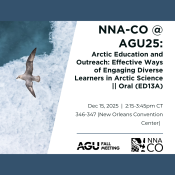
NNA-CO at AGU25: ED13A - Arctic Education and Outreach: Effective Ways of Engaging Diverse Learners in Arctic Science
The changing polar environments have created important scientific and societal concerns in high and lower latitudes. In this session, we will share effective approaches, frameworks and examples of how to promote a broad understanding and awareness of the changing Arctic and the related societal implications. The session will highlight effective strategies to inspire learners in both formal and informal learning contexts as well as communities. We also invite papers on effective ways of community engagement, co-design of educational and outreach activities, and fostering intergenerational or cross-cultural learning through Arctic Indigenous knowledge, science, and observation.
New Resource Available - Arctic Scientists in the Classroom: Principles for Designing Community-Centered Educational Programs
The best practices for science education and outreach in the Arctic has shifted dramatically over the past 30 years as “parachute scientists” presentations in classrooms have gradually been replaced by youth-centered approaches. This mini-course introduces you to principles of evidence-based, community-centered design of science outreach and education programming in the Arctic. Through concrete examples, the mini-course will demonstrate how instructional design theory and co-production of knowledge frameworks can guide and enhance outreach project development. Examples include projects from the NSF Navigating the New Arctic initiative and NASA Science Activation Arctic and Earth SIGNs project. You will leave with an outreach program planning guide incorporating the key considerations and evidence based design for their research in Arctic classrooms or communities.
2026 NNA Annual Community Meeting
The 2026 Navigating the New Arctic (NNA) Annual Community Meeting is an in-person meeting for the NNA initiative. This year's meeting will take place from September 15-17, 2026 at the Wood Center on the University of Alaska Fairbanks (UAF) campus.