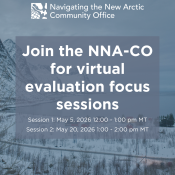
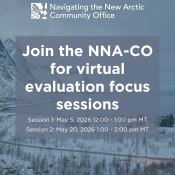
Evaluation Focus Sessions
Join the NNA-CO on May 20, 2026 at 1 pm MT for virtual evaluation focus sessions that will inform the upcoming NNA evaluation and synthesis report. These sessions will consist of an overview of topics, questions, and methods planned for the comprehensive report, as well as time for participants to share and learn from others who are implementing evaluations of NNA-funded projects. Register here.
NSF Office of Polar Programs (NSF OPP) Updates Office Hour
Please join NSF OPP leadership and staff on May 7 at 1:30pm ET for an office hour to discuss recent organizational updates and what to expect going forward. The goal of this event is to help researchers understand how these changes may affect proposal development and review, and to answer questions from the research community. The session will also offer insight into how OPP operates and is intended to help current and prospective investigators strengthen future proposals.
Morgan, A.N., Chi, G., Gavenus, E.R., Husserl, J., Henry, T.B., Sims, C.B., and Miller, D.L., 2025: 3E + 3B: An Elaborated One Health Approach to Bridging the Researcher-Stakeholder Disconnect at the Food-energy-water Nexus Within Circular Bioeconomies, Circular Economy and Sustainability, 5, https://doi.org/10.1007/s43615-025-00651-y
Hughes, A.G., Wahl, S., Jones, T.R., Zuhr, A., Hörhold, M., White, J.W.C., and Steen-Larsen, H.C., 2021: The role of sublimation as a driver of climate signals in the water isotope content of surface snow: laboratory and field experimental results, The Cryosphere, 15(10), https://doi.org/10.5194/tc-15-4949-2021
Issue 11 - Spring 2026
- Classroom Resources
- New place-based science resources for Alaska
- Inspiring science books for your classroom: A note from Patty Brown, ASTA President
- Science Stars
- Congratulations to the Alaska Science & Engineering Fair winners!
- Bethel’s First LEGO League Dirt Busters team wins award at the Western Alaska Interdisciplinary Science Conference
- Celebrating Science
- Interior Alaska Science Fair draws over 400 projects
- Opportunities for Educators
- Anchored in Data: Bring Alaska Mariculture into Your Classroom
- Applications now open for the Alaka Knowledge, Science, and Education Alliance!
- Summer Wildfire and Wildlife Course for Educators in Denali National Park
- Summer professional development opportunities with AK DEED
- Plan ahead for 2027!
- Opportunities for Students
- Open enrollment for UAA's Summer Engineering Academies
- Sign up for the summer 2026 Bonanza Creek Science Adventure Camp!
- Application open for the Arctic STEM Summer Camp
- "Between the Lines" summer camps available at Sitka Sound Science Center