Alaska
Emergency Response in the Arctic (ERA): Investments for Global Capabilities and Local Benefits
The Arctic has been experiencing significantly longer ice-free, navigable maritime seasons, thereby changing the types of activities taking place in Arctic waters. Cruise ships are travelling through the Northwest Passage, oil exploration is occurring off the North Slope of Alaska, and the Northern Sea Route is seeing an increasing volume of cargo ships travelling through it.
Origin and Fate of Harmful Algal Blooms in the Warming Chukchi Sea
The Pacific sector of the Arctic Ocean is warming, in particular the shallow Chukchi Sea. As a result, it is anticipated that many organisms may migrate northward or become more abundant as air and ocean temperatures continue to warm. However, few pose such significant threats to human and ecosystem health as harmful algal bloom (HAB) species.
Adapting to Climate Change in the Middle Kuskokwim
Alaska Native Tribal Health Consortium (ANTHC)
In 2018, the Georgetown Tribal Council received a Bureau of Indian Affairs Tribal Resiliency Program Grant to create a climate vulnerability assessment and adaptation plan for the Middle Kuskokwim region. The Alaska Native Tribal Health Consortium (ANTHC) was contracted to facilitate the climate change adaptation planning process, and develop the final climate change vulnerability assessment and adaptation plan in collaboration with the communities of Lower Kalskag, Upper Kalskag, Aniak, Chuathbaluk, Napaimute, Crooked Creek, Georgetown, Red Devil, Sleetmute, and Stony River.
2021
Community Observations on Climate Change: Arctic Village, Fort Yukon and Venetie, Alaska
Alaska Native Tribal Health Consortium (ANTHC)
For the Upper Yukon area, climate change has become a daily fact of life, causing a wide range of impacts to the environment, and in some cases to community health. In 2015 the Alaska Native Tribal Health Consortium (ANTHC) and the U.S. Geological Survey (USGS) organized a climate change impacts assessment in Arctic Village, Fort Yukon, and Venetie.
2016
Comprehensive Economic Development Strategy 2020-2024
Southwest Alaska Municipal Conference
The purpose of the Comprehensive Economic Development Strategy (CEDS) is engagement with stakeholders: local governments, businesses, associations, membership organizations, tribes, and State and Federal agencies to implement the collective best practices for the improvement of the regional economy. The CEDS is to be an evolving, guiding document for SWAMC, providing direction that supports economic development in the region backed by quantifiable data and the insight of our leadership.
2020
Improving Local Participation in Research in Nortwest Alaska
University of Alaska
In conjunction with the Northwest Arctic Borough, the Chukchi Campus of the University of Alaska Fairbanks organized the Workshop on Improving Local Participation in Research in Northwest Alaska. The National Science Foundation funded the workshop in its continuing effort to improve relations between researchers and local residents. The workshop occurred in Kotzebue April 2-4, 2013.
2013
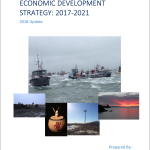
Bristol Bay Comprehensive Economic Development Strategy: 2017-2021
Bristol Bay Native Association
"Through the Bristol Bay CEDS and other initiatives, the region is implementing the Bristol Bay Regional Vision. The Bristol Bay Partnership with Bristol Bay Native Association as the lead organization sponsored the Vision to hear from the people about their hopes and dreams for the future. The CEDS is a planning tool used to map out where Bristol Bay wants to go, reduce redundancies, attract investment, and encourage partnerships."
2018
Climate Change Adaptation Plan
Central Council of the Tlingit & Haida Indian Tribes of Alaska
"Tlingit & Haida has worked to determine what changing climate conditions will occur in southeast Alaska and potentially affect all southeast Tribes; and prioritized each area of concern with a ranking based off of vulnerability and importance to the citizens and culture alike."
2019
Sustainable Transitions through Arctic Redevelopment (STAR)
With the launch of the Decade on Ecological Restoration by the United Nations in 2021, momentum is growing towards visioning a sustainable future for aging industrial sites worldwide. In the Arctic, these aging sites, including mining operations, have experienced immense neglect in part due to the remoteness of the region. With climate warming leading to increased ice and permafrost melt and expanded access to the region, these sites are increasingly vulnerable to further deterioration but pose an opportunity to understand how these sites can be developed for the future.
Researching apun: Students Using Local, Traditional, and Science Knowledge Bases to Investigate Arctic Snow Processes
The Arctic is warming more rapidly than elsewhere on Earth, and the community of Utqiaġvik, AK, the home of the Inupiat people, has a unique perspective from which they are observing this profound change. This collaboration between the University of Michigan (U-M) and Ilisagvik College, located in Utqiaġvik, will support the development of a course-based research experience for undergraduates at Ilisagvik College and will also support basic research on Arctic snow.