-
-
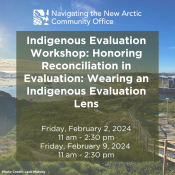
The Indigenous Evaluation Workshop: Honoring Reconciliation in Evaluation: Wearing an Indigenous Evaluation Lens, was held in two parts in February 2024 for the broader Navigating the New Arctic community. The first session introduced participants to Indigenous evaluation by examining personal perceptions, bridging Western and Indigenous evaluative approaches, and practicing the use of foundational evaluation tools. The second session, guided participants to explore a decolonized lens for defining and measuring success, examined gaps in current metrics, and considered how evaluators can act as agents of change. Together, the workshops emphasized strength-based approaches that honor and uphold Indigenous Knowledge within research and evaluation contexts.
-
The NNA-CO hosted a series of virtual workshops on science storytelling, that culminated in a presentation of stories at the NNA Annual Community Meeting in March 2024. This session, "Science Storytelling Series - Creating Virtual Tours with Infiniscope" focused on creating virtual tours. Infiniscope shared tips and lessons learned and demonstrated examples of virtual tours from a community-based project in Hawaii and Polar Explorer.
-
-
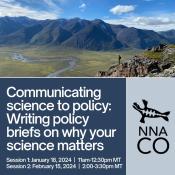
In the Communicating science to policy: Writing policy briefs on why your science matters webinar, the Navigating the New Arctic Community Office (NNA-CO) and the Study of Environmental Arctic Change (SEARCH) welcomed participants to an online workshop series to help researchers and collaborators communicate with policymakers. The sessions guided participants in preparing two-page “Arctic Answers” for publication in Arctic, Antarctic, and Alpine Research (AAAR) and provided opportunities for hands-on development of briefs with experienced guidance. The workshops focused on helping researchers share scientific and Indigenous knowledge in clear, concise language to inform decision-making amid accelerating environmental change in the Arctic.
-
The AGU presentation, "Towards an 'Arctic Together': Supporting an Inclusive and Diverse Community through the Navigating the New Arctic Community Office" took place on December 15, 2023 from 10:37 to 10:46 MT. The Navigating the New Arctic Community Office (NNA-CO) built awareness, partnerships, opportunities, and resources for collaboration and equitable knowledge generation within, between, and beyond research projects funded by NSF’s Navigating the New Arctic (NNA) Initiative. In the presentation, the NNA-CO reviewed how it incorporated equity and inclusion into its values, architecture, governance, and activities, and reflected on challenges confronting collaborative and co-production research within NNA.
-
The AGU session, "Arctic Education & Outreach - Effective Ways of Engaging Diverse Learners in Arctic Science" took place on December 13, 2023 from 9:30 am to 11:00 am MT. The session addressed how changing polar environments had created important scientific and societal concerns in high and lower latitudes. Presenters shared effective approaches, frameworks, and examples to promote broader understanding and awareness of the changing Arctic and its societal implications. The session highlighted strategies to inspire learners in formal and informal contexts and invited papers on community engagement, co-design of educational and outreach activities, and fostering intergenerational and cross-cultural learning through Arctic Indigenous knowledge, science, and observation.